
The translog production function can be expressed as:
𝑌 = 𝑓(𝑥1, 𝑥2 ….. , 𝑥𝑛)
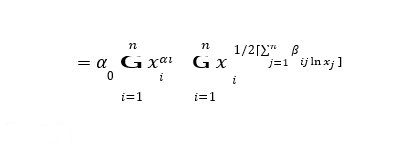
Where,
Y: Output
𝛼0: Efficiency Parameter
𝛼𝑖 𝑎𝑛𝑑 𝛽𝑖𝑗: 𝑃𝑎𝑟𝑎𝑚𝑒𝑡𝑒𝑟𝑠 (𝑈𝑛𝑘𝑛𝑜𝑤𝑛)
𝑥𝑗: 𝐼𝑛𝑝𝑢𝑡 𝑗
Logarithm Form:
Taking log both sides, we obtain:

The translog production function is a generalisation of the Cobb-Douglas production function. For 𝛽𝑖𝑗 = 0, the log form of the translog function reduces to a Cobb-Douglas production function. It is linear in parameters, so it can be estimated using the least squares method.
Monotonicity and Translog Production Function:
The marginal product, i.e. addition to the total product due to the addition of one more factor, is-
𝑀𝑃𝑖 = ∂Y/∂xi = ∂lnY/∂lnxi . 𝑌/𝑥𝑖
Where ∂lnY/∂lnxi is the production elasticity which can be calculated from log form.

∂lnY/∂lnxi =
- MP of xi can be positive for a range in values of xj but can be negative if 𝛽𝑖𝑗 > 0
- (all i,j) and xj → 0. If there exists at least one 𝛽𝑖𝑗 < 0, then 𝑀𝑃𝑖 < 0 𝑎𝑠 xj → ∞. Thus, the translog function is not monotonic.
Are Isoquants under Translog Function Convex?
The isoquants are strictly quasi-convex if the Bordered Hessian matrix is negative definite. In order to construct a Bordered Hessian matrix, we need to derive second direct and cross-partial derivatives using the chain rule.

Here the values of the first and second partial derivatives vary with input levels, and there is no guarantee that the isoquants are globally convex.
Read More- Microeconomics
- Microeconomics: Definition, Meaning and Scope
- Methods of Analysis in Economics
- Problem of Choice & Production Possibility Curve
- Concept of Market & Market Mechanism in Economics
- Concept of Demand and Supply in Economics
- Concept of Equilibrium & Dis-equilibrium in Economics
- Cardinal Utility Theory: Concept, Assumptions, Equilibrium & Drawbacks
- Ordinal Utility Theory: Meaning & Assumptions
- Indifference Curve: Concept, Properties & Shapes
- Budget Line: Concept & Explanation
- Consumer Equilibrium: Ordinal Approach, Income & Price Consumption Curve
- Applications of Indifference Curve
- Measuring Effects of Income & Excise Taxes and Income & Excise Subsidies
- Normal Goods: Income & Substitution Effects
- Inferior Goods: Income & Substitution Effects
- Giffen Paradox or Giffen Goods: Income & Substitution Effects
- Concept of Elasticity: Demand & Supply
- Demand Elasticity: Price Elasticity, Income Elasticity & Cross Elasticity
- Determinants of Price Elasticity of Demand
- Measuring Price Elasticity of Demand
- Price Elasticity of Supply and Its Determinants
- Revealed Preference Theory of Samuelson: Concept, Assumptions & Explanation
- Hicks’s Revision of Demand Theory
- Choice Involving Risk and Uncertainty
- Inter Temporal Choice: Budget Constraint & Consumer Preferences
- Theories in Demand Analysis
- Elementary Theory of Price Determination: Demand, Supply & Equilibrium Price
- Cobweb Model: Concept, Theorem and Lagged Adjustments in Interrelated Markets
- Production Function: Concept, Assumptions & Law of Diminishing Return
- Isoquant: Assumptions and Properties
- Isoquant Map and Economic Region of Production
- Elasticity of Technical Substitution
- Law of Returns to Scale
- Production Function and Returns to Scale
- Euler’s Theorem and Product Exhaustion Theorem
- Technical Progress (Production Function)
- Multi-Product Firm and Production Possibility Curve
- Concept of Production Function
- Cobb Douglas Production Function
- CES Production Function
- VES Production Function
- Translog Production Function
- Concepts of Costs: Private, Social, Explicit, Implicit and Opportunity
- Traditional Theory of Costs: Short Run
- Traditional Theory of Costs: Long Run
- Modern Theory Of Cost: Short-run and Long-run
- Modern Theory Of Cost: Short Run
- Modern Theory Of Cost: Long Run
- Empirical Evidences on the Shape of Cost Curves
- Derivation of Short-Run Average and Marginal Cost Curves From Total Cost Curves
- Cost Curves In The Long-Run: LRAC and LRMC
- Economies of Scope
- The Learning Curve
- Perfect Competition: Meaning and Assumptions
- Perfect Competition: Pricing and Output Decisions
- Perfect Competition: Demand Curve
- Perfect Competition Equilibrium: Short Run and Long Run
- Monopoly: Meaning, Characteristics and Equilibrium (Short-run & Long-run)
- Multi-Plant Monopoly
- Deadweight Loss in Monopoly
- Welfare Aspects of Monopoly
- Price Discrimination under Monopoly: Types, Degree and Equilibrium
- Monopolistic Competition: Concept, Characteristics and Criticism
- Excess Capacity: Concept and Explanation
- Difference Between Perfect Competition and Monopolistic Competition
- Oligopoly Market: Concept, Types and Characteristics
- Difference Between Oligopoly Market and Monopolistic Market
- Oligopoly: Collusive Models- Cartel & Price Leadership
- Oligopoly: Non-Collusive Models- Cournot, Stackelberg, Bertrand, Sweezy or Kinked Demand Curve
- Monopsony Market Structure
- Bilateral Monopoly Market Structure
- Workable Competition in Market: Meaning and Explanation
- Baumol’s Sales Revenue Maximization Model
- Williamson’s Model of Managerial Discretion
- Robin Marris Model of Managerial Enterprise
- Hall and Hitch Full Cost Pricing Theory
- Andrew’s Full Cost Pricing Theory
- Bain’s Model of Limit Pricing
- Sylos Labini’s Model of Limit Pricing
- Behavioural Theory of Cyert and March
- Game Theory: Concept, Application, and Example
- Prisoner’s Dilemma: Concept and Example